
Updated September 2026 | 10 min read

Anyone who’s used a bowl regularly knows the two recurring annoyances: clearing out spent ash between sessions, and loading fresh material back in without making a mess. Two different product categories have emerged to solve these problems — dedicated debowler ashtrays, built specifically around ash clearing, and multi-purpose tools that handle several smoking-related tasks at once.
This guide compares both approaches directly: what each one actually does, where each one excels, and where a multi-tool’s broader functionality changes the calculation compared to a single-purpose ashtray.
Table of Contents
What Is a Debowler Ashtray?
A debowler ashtray is a dedicated ashtray built around a central spike or poker — commonly made from plastic, silicone, or glass, depending on the specific product — positioned to let you invert a pipe or bowl and clear spent ash directly into the tray below. Products in this category, including the Debowler brand ashtrays, are built specifically for this single task: ash clearing, cleanly and without mess.
The core design is found in many ash-clearing tools in this category — a raised center point the pipe’s bowl rests against or is pressed onto, surrounded by a wider tray that catches the ash as it falls loose.
How a Debowler Ashtray Works
Using a debowler-style ashtray is straightforward by design. You invert your pipe or bowl piece and press it against the center spike, using it to break up and dislodge compacted ash and residue from inside the bowl. As the material loosens, it falls directly into the surrounding tray rather than scattering across a table or countertop.

Most ash-clearing tools in this category work best on cooled pipes rather than pieces still holding hot embers. Depending on the specific product and material, some are dishwasher safe or otherwise easy to wipe clean between uses. The spike is designed to break up compacted ash, while the surrounding tray is sized to contain the mess from a full cleaning session.
What Is a Multi-Tool?
A smoking multi-tool is a compact accessory that combines several functions — commonly some combination of scraping, scooping, poking, and tamping — into a single piece, usually made from stainless steel or another durable material.
Rather than being built around one specific task the way a debowler ashtray is, a multi-tool is designed to handle multiple stages of a smoking or preparation routine: clearing residue from a bowl, scraping buildup from a grinder, loading ground material into a bowl or vaporizer chamber, and in some designs, tamping or adjusting material during a session.
Debowler Ashtray vs. Multi-Tool

| Factor | Debowler Ashtray | Multi-Tool |
|---|---|---|
| Primary function | Ash clearing and containment | Multiple functions (scraping, scooping, poking) |
| Loading capability | None | Yes, with a scoop end |
| Grinder maintenance | None | Yes, with a scraper/pick end |
| Portability | Bulkier, stays on a table or shelf | Compact, pocket-sized |
| Mess containment | Built-in tray catches ash directly | No built-in tray — used alongside a separate tray or surface |
| Best single use case | Emptying a bowl at the end of a session | Handling multiple prep-and-clean tasks in one tool |
Which Is Better for Cleaning Bowls?
For the specific task of clearing ash after a session, a dedicated ash-clearing tool generally has the edge. The built-in tray solves the containment problem directly — ash falls into a designated space rather than needing to be caught, brushed off, or wiped up separately. This is the one job the category is built entirely around, and it does that job well.
A multi-tool’s pointed or scraper end can also clear ash and light residue from a bowl, but without a built-in tray, you’re either doing this over a separate ashtray, trash can, or surface anyway. For ash clearing specifically, in isolation, a dedicated debowler-style ashtray is the more purpose-built solution.
Which Is Better for Loading Bowls?
This is where the comparison flips. A standard ash-clearing tool has no loading function at all — it’s built around ash removal, not material transfer. Loading ground herb into a bowl with this type of ashtray still requires using your fingers or a separate tool.
A multi-tool with a scoop end handles this directly: transferring ground material from a grinder into a bowl or vaporizer chamber cleanly, without spilling or needing to handle the material by hand. For anyone who finds loading messier or more frustrating than ash clearing, a multi-tool’s scoop function fills a gap that a debowler bowl cleaner doesn’t address at all.
Can a Multi-Tool Replace a Debowler Ashtray?
Partially, depending on what you value most. A multi-tool with a pointed or scraper end can clear ash from a cooled bowl in a similar way to a debowler’s center spike — the underlying mechanic (poking and breaking up compacted ash) is comparable. What a multi-tool doesn’t replicate is the built-in tray and containment system that makes a dedicated ash-clearing tool convenient specifically for that task.
If ash containment in one dedicated spot matters to you, a multi-tool alone doesn’t fully replace that. If you’re comfortable clearing ash over an existing ashtray, trash can, or sink and want a tool that also handles loading, scraping, and other tasks, a multi-tool covers meaningfully more ground.
Can You Use a Debowler Ashtray for Loading a Bowl?
Not directly. A debowler-style ashtray is designed around one function — clearing and containing spent ash — and doesn’t include any scoop, spoon, or material-transfer feature. Loading fresh ground herb into a bowl with a debowler ashtray on hand still means using your fingers or reaching for a separate tool entirely.
This is the clearest functional line between the two categories: a debowler is built for clearing and containment, while a multi-tool is built to cover clearing, loading, scraping, and sometimes tamping in one piece. Neither approach is wrong — they’re just solving for a different scope of the overall routine.
When a Debowler Ashtray Makes More Sense
- You want a dedicated, stationary spot for ash disposal — something that stays on a table or desk and handles that one job consistently
- You primarily use bowls or pipes rather than a broader mix of accessories that also need cleaning or loading
- Containment matters more than portability — an ash-clearing tool like this isn’t meant to travel in a pocket the way a compact multi-tool is
- You don’t need a scoop or loading function and are handling that part of the process another way already
When a Multi-Tool Makes More Sense
- You want one compact tool that travels with you, rather than a stationary tray-based accessory
- Loading is a bigger pain point than ash clearing in your typical routine
- You maintain a grinder regularly and want a tool that also scrapes and collects kief, not just clears bowls
- You’re trying to consolidate accessories rather than adding another dedicated single-purpose item to your setup
Why a Multi-Tool Can Be More Versatile
The core difference comes down to scope. A debowler-style ashtray is built around a single, specific task and does it well. A multi-tool is built around covering several adjacent tasks — bowl clearing, grinder maintenance, and material loading — that come up across a typical smoking and preparation routine, not just the moment of emptying a bowl.
This doesn’t make a multi-tool universally “better” — it makes it a different kind of tool, solving a broader set of problems rather than optimizing deeply for one. For anyone whose routine involves more than just ash clearing (grinding, loading, occasional kief collection), that broader coverage is where a multi-tool’s value becomes clearest.
Keefer Scraper: A Multi-Tool for Bowls, Grinders, Trays & More
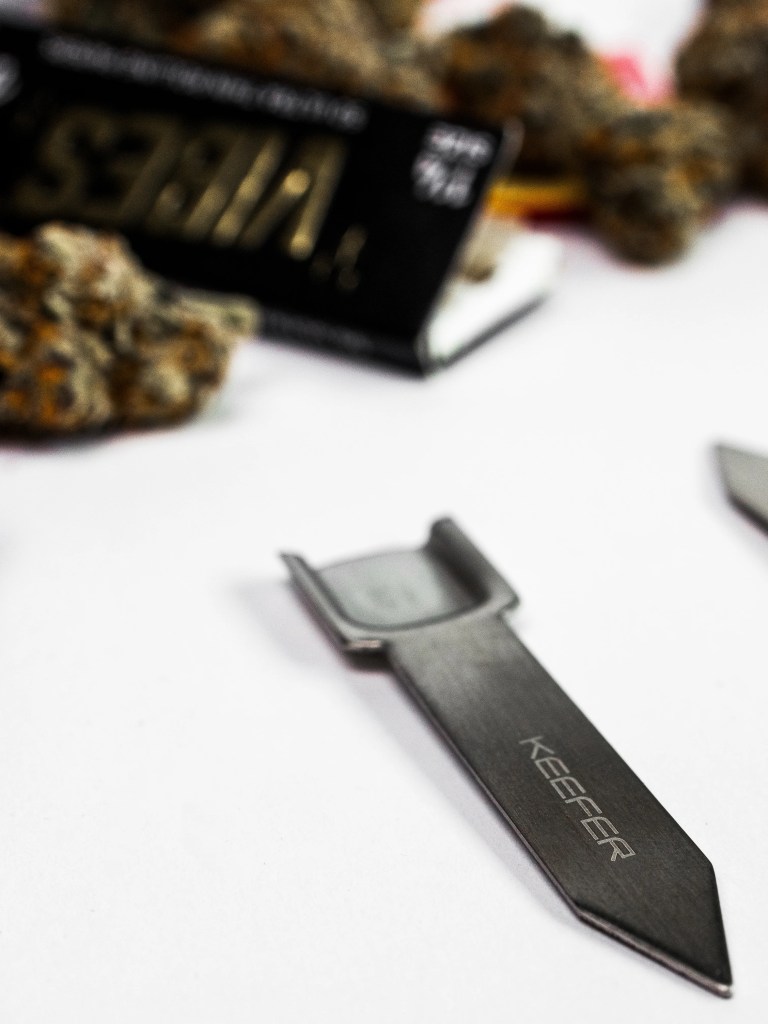
The Keefer Scraper and Keefer Scraper Mini are built around the multi-tool approach described throughout this guide — dual-ended stainless steel tools that cover several stages of a typical routine rather than one single task.
The pointed end can help break up and remove cooled ash and residue from bowls, providing a similar basic poking/scraping function to the spike found on many debowler-style ashtrays — though without a built-in tray, it doesn’t replicate the dedicated containment a debowler ashtray provides. The same pointed end also scrapes grinder buildup and reaches corners a debowler ashtray was never designed for.
The scoop end covers the loading function a debowler ashtray doesn’t address at all — transferring ground material from a grinder into a bowl or vaporizer chamber cleanly.
Together, this covers bowl maintenance, grinder maintenance, and loading in a single compact tool — the Original Keefer Scraper (1-inch scoop) for standard grinders and larger bowls, or the Keefer Scraper Mini (1/2-inch scoop) for tighter spaces like small vaporizer chambers.
Looking for a compact alternative to a dedicated debowler-style tool? The Keefer Scraper combines a pointed scraping end with a scoop for loading, giving you multiple functions in one compact stainless-steel tool.

For anyone weighing a dedicated ashtray with a poker against a more portable option, the honest answer depends on whether ash containment in one fixed spot matters more to you than portability and broader task coverage. If it’s the latter, a multi-tool like the Keefer Scraper is worth evaluating directly against your typical routine.
Frequently Asked Questions
What is a debowler ashtray used for?
A debowler ashtray is used to clear spent ash and residue from a cooled pipe or bowl. A raised center spike breaks up compacted material as you invert the piece against it, and the surrounding tray catches the ash so it doesn’t scatter across a surface.
Does a debowler ashtray work on all pipes?
Most debowler-style ashtrays are designed to work with standard hand pipes and bowl pieces, though the fit and effectiveness can vary depending on the specific shape and size of the bowl being cleared. They generally work best on cooled pieces rather than ones still holding hot embers.
Can I use a multi-tool instead of a debowler ashtray?
A multi-tool with a pointed or scraper end can clear ash from a bowl in a broadly similar way, but without a built-in tray, you’ll need a separate surface or container to catch the ash. Whether that trade-off is worth it depends on how much you value dedicated containment versus a more compact, multi-purpose tool.
What’s the difference between a debowler ashtray and an ashtray with a poker?
These generally describe the same category — an ashtray with a built-in spike or poker specifically designed to clear bowls, as opposed to a standard ashtray with no clearing mechanism.
Is a bong bowl cleaner different from a pipe debowler?
The core concept is similar — a pipe cleaning tool designed to clear residue and buildup — though bong bowl cleaning sometimes involves additional steps like soaking or brushing, given bong bowls tend to accumulate resin differently than a hand pipe.
What should I look for in a smoking accessory multi-tool?
A few features matter most: a pointed or scraping end for clearing bowls and residue, a scoop end for loading material without using your fingers, durable construction such as stainless steel, and a compact size that’s easy to carry. Beyond that, the right multi-tool depends on which tasks come up most in your own routine — some designs, like the Keefer Scraper, combine several of these functions in one dual-ended tool, while others focus on just one or two.
Do I need both a debowler ashtray and a multi-tool?
Some people do use both — a debowler ashtray as the stationary home-base solution for ash containment, and a multi-tool for portability, grinder maintenance, and loading. Whether you need both depends on how much of your routine happens at one fixed location versus on the go.
Bottom Line
A debowler-style ashtray and a multi-tool solve overlapping but genuinely different problems. For dedicated ash containment at a single location, a purpose-built debowler ashtray remains the more focused option — that’s the one job it’s designed around, and it does it well. For loading, grinder maintenance, and portability, a multi-tool covers meaningfully more ground, including a task (loading) that a debowler ashtray doesn’t address at all.

The right choice depends on which part of your routine causes the most friction. If it’s ash clearing specifically and you want a dedicated tray-based solution, a debowler ashtray does that well. If your frustration spans loading, grinder buildup, and general portability, a multi-tool for weed like the Keefer Scraper covers a broader set of everyday tasks in one compact accessory.
Related Reading:
- What Is a Lighter Sleeve Poker & Tamper Tool? How It Works & What to Pair It With
- Best Pipe Tamper Multi Tools: 5 Must-Have Features
- How to Clean a Grinder Without Losing Kief
- 10 Essential Weed Smoking Tools Every Cannabis User Should Own in 2026
